
7% Mortgage Rates Are Creating Two Very Different Housing Markets
/There is an old saying in real estate that all real estate is local. In today's market, I would add something else: all buyers are not experiencing the same real estate market.
Mortgage rates have climbed back above 7%, and that matters enormously if you are financing most of a home purchase. The Mortgage Bankers Association reported a 30-year fixed rate of 7.12% in late September, the highest level in more than two years. Freddie Mac's measure was also above 7%. Economists surveyed by Reuters expect rates to remain elevated well into 2027, which means this is not necessarily a problem buyers can solve simply by waiting a few months.
What is particularly interesting in South Florida is that the effect changes dramatically depending upon the buyer's price range and financial position.
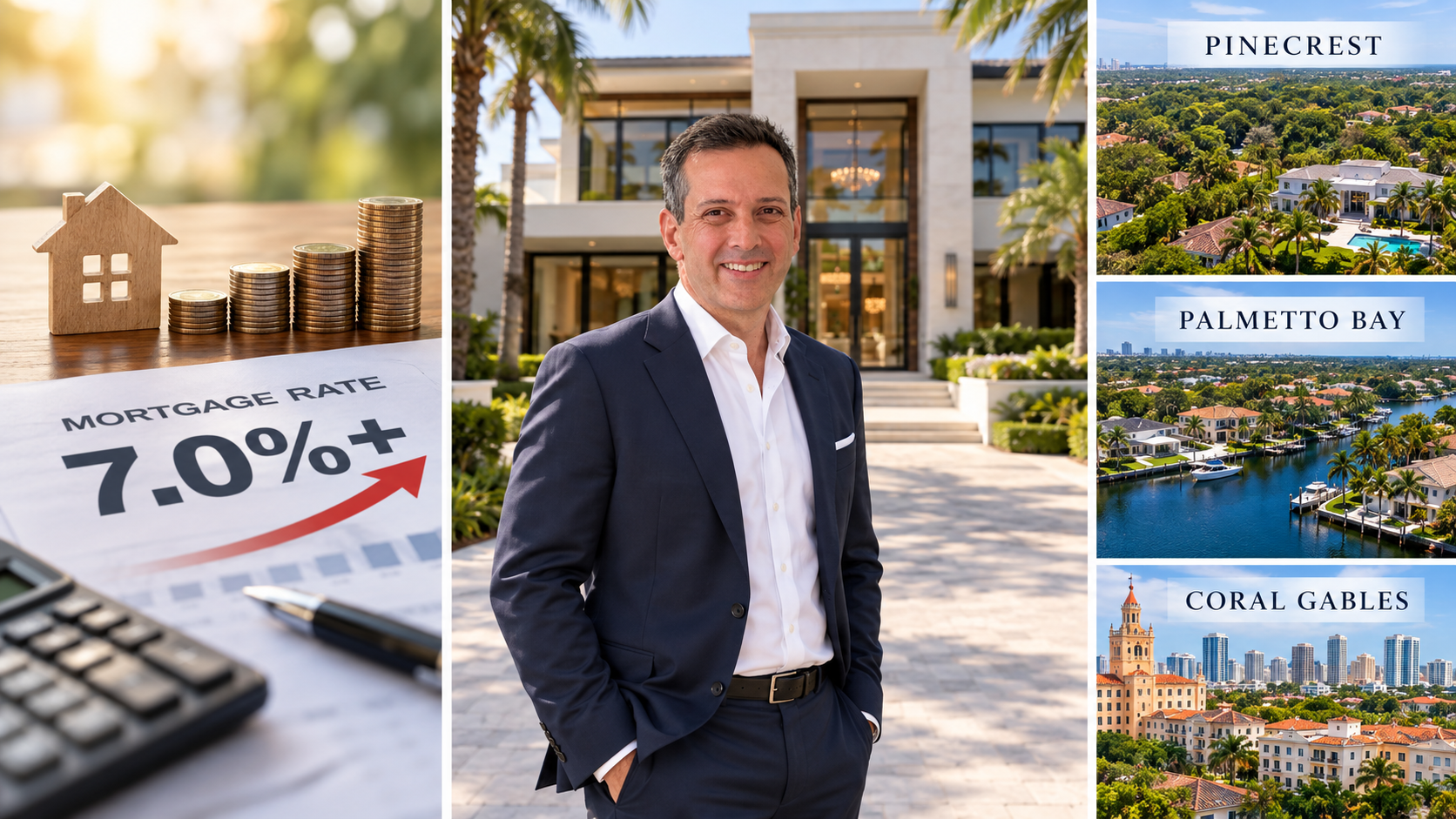
The lower the price range, the more rates matter
For the first-time buyer, today's rates can be brutal. These buyers generally have smaller down payments, less accumulated wealth and tighter debt-to-income ratios. A change in the mortgage rate doesn't merely make the house more expensive. It can determine whether the buyer qualifies at all.
Consider a buyer financing $600,000. Moving from a 5% mortgage to one that is slightly more than 7% adds roughly $800 per month in principal and interest alone. Property taxes and insurance haven't become any cheaper either, particularly in South Florida.
That buyer has several choices, and none is particularly appealing: buy a less expensive house, put substantially more money down, accept a much higher monthly payment or stay on the sidelines.
This helps explain why Miami's broader housing market looks far less robust than its luxury market. Realtor.com's September data show the median sold price in Miami down approximately 1.9% from a year ago, while Miami-Dade's median listing price is down about 2.4%. Realtor.com currently characterizes Miami-Dade as a buyer's market.
The move-up buyer has a different problem
The next group is one I encounter frequently in Pinecrest and Palmetto Bay: homeowners who can afford to move but aren't sure they want to.
Many purchased or refinanced when mortgage rates were 3% or 4%. They may have hundreds of thousands of dollars of equity in their current home, yet moving from that inexpensive mortgage into a 7% mortgage can dramatically increase their monthly housing expense.
Suppose a Palmetto Bay homeowner has a $500,000 mortgage at 3.25% and wants to move into a $1.5 million home. Even with considerable equity available for the down payment, the new mortgage could easily carry a rate more than twice what they are paying today.
They haven't become poorer. The economics of moving have simply become much less attractive.
This "lock-in effect" removes both buyers and sellers from the market. The homeowner who doesn't move isn't buying the next house, but also isn't putting the current house on the market. That helps explain one of the oddities of the current cycle: high rates have reduced demand, but they have also restricted supply.
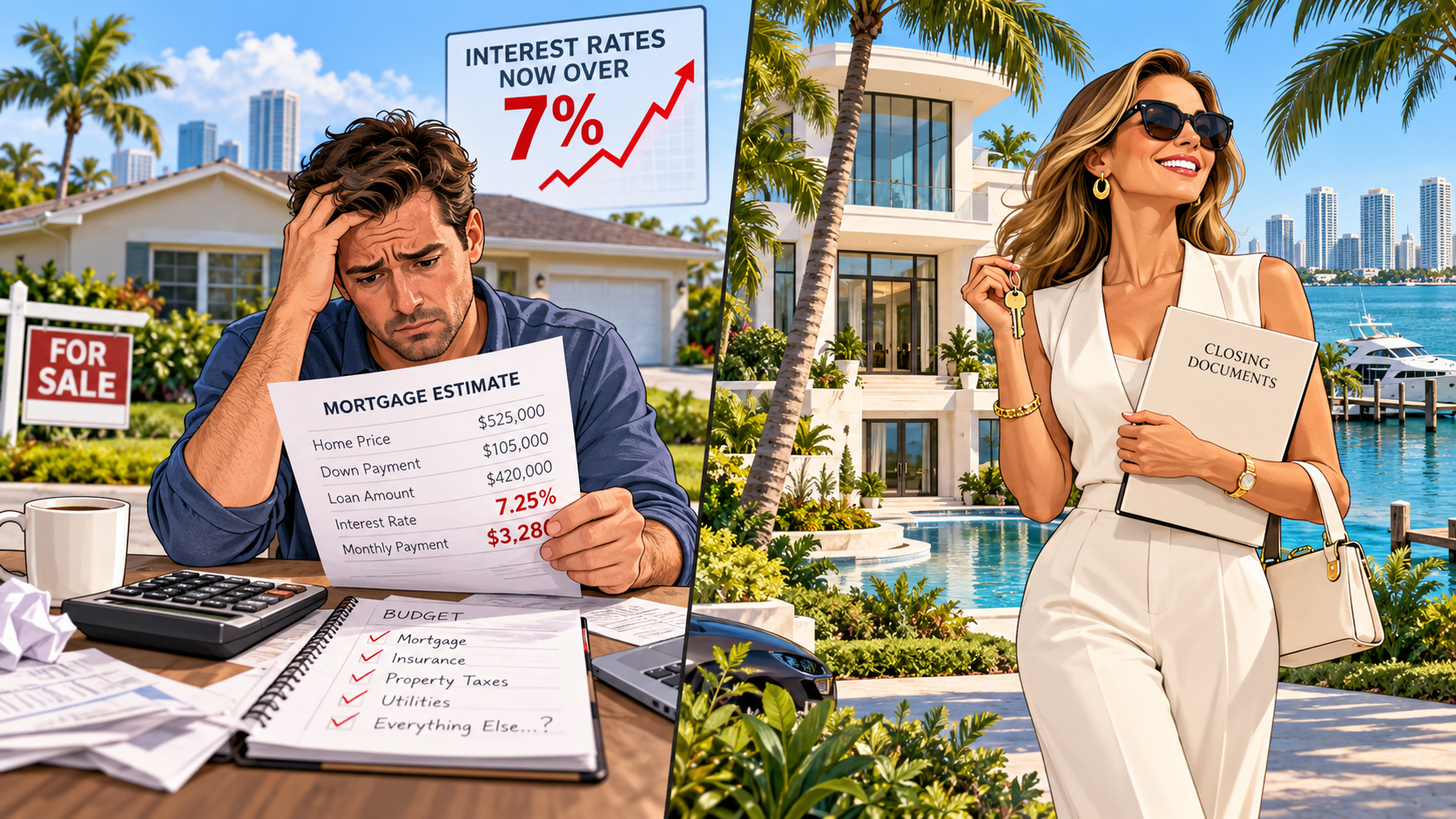
Now look at Pinecrest
Pinecrest illustrates how different the market can look when we move higher up the economic ladder.
According to Redfin's latest three-month data through August, the median Pinecrest sale price was approximately $2.42 million, up 8.3% from a year earlier. Sales volume increased 36%, while the average marketing time dropped substantially from the previous year.
That is happening while mortgage rates are above 7%.
The important point isn't that interest rates don't matter in Pinecrest. They do. Rather, a much larger percentage of buyers at this level have the financial flexibility to reduce the effect. They may make a 40% or 50% down payment instead of 20%. They may sell another property first. They may borrow against investment assets. Some simply pay cash.
At a certain wealth level, the mortgage rate changes from being an affordability issue into a financial-planning issue. That distinction matters.
A buyer trying to qualify for a $750,000 house asks, "Can I afford this payment?" A buyer purchasing a $4 million Pinecrest home may be asking, "Does it make more sense to finance this at 7% or leave my money invested elsewhere?"
Those are very different conversations.
Palmetto Bay occupies an interesting middle ground
Palmetto Bay gives us another useful comparison. Its median sale price over the three months ending in August was approximately $1.27 million, according to Redfin, up 21.3% year over year. Sales were also up more than 22%.
I would be cautious about reading too much into a single year's median-price increase because Palmetto Bay has far fewer transactions than Miami-Dade as a whole. Changes in the mix of homes sold can move the median considerably. Still, the direction is noteworthy.
Palmetto Bay attracts both conventional move-up buyers and wealthier buyers who might otherwise consider Pinecrest. That makes it particularly sensitive to the dividing line in today's market. A buyer financing a large percentage of a $1.2 million purchase feels 7% interest rates quite acutely. A buyer arriving with $700,000 from the sale of another home may view the exact same property very differently.
Two buyers can therefore look at the same Palmetto Bay house and experience two completely different affordability equations.
Coral Gables tells a similar story
Coral Gables provides another useful comparison because its housing stock stretches from relatively attainable condominiums and smaller homes to waterfront estates costing many millions of dollars.
Redfin reports a median sale price of about $1.4 million over the three months ending in August, up 7.4% year over year. But homes were taking approximately 98 days to sell, compared with 78 days a year earlier.
That combination is important. Prices can remain high while buyers become more selective.
We are already seeing more of that throughout South Florida. A properly priced, updated home in a desirable location can still sell very well. An overpriced home may sit for months. Today's buyers generally aren't behaving as though they must purchase whatever becomes available before someone else gets it. That is a major change from 2021 and 2022.
Then we reach the luxury market
This is where the numbers become remarkable.
Redfin reported this month that Miami luxury home prices increased 18% year over year during the three months ending in July, the largest increase among the 50 largest U.S. metropolitan areas.
Meanwhile, Miami's non-luxury home prices declined 1.3%. Luxury prices up 18%. Non-luxury prices down 1.3%. Same metropolitan area. Same mortgage rates. That may be the single statistic that best explains our current market.
Redfin puts the median Miami luxury sale at just over $5 million and reports that luxury sales increased 8.8% year over year. The company specifically attributes part of that strength to affluent buyers being considerably less constrained by mortgage rates and economic uncertainty than typical purchasers.
That phenomenon is especially relevant to Pinecrest and Coral Gables, where $2 million is no longer necessarily the top of the market. It may simply be the entry point for a home.
For the buyer purchasing a $750,000 or $1 million property with conventional financing, 7% rates can change everything. For a buyer shopping for a $4 million Pinecrest estate with substantial liquid assets, they may change very little.
Does this mean prices can keep rising?
Probably not everywhere. This is where I think the word "correction" needs to be used carefully.
There is increasing evidence that the housing market is correcting, but most economists do not appear to expect a 2008-style collapse. A Reuters survey published September 15 forecasts only about 1.5% national home-price appreciation in 2026 and 2.3% in 2027, both below the general rate of inflation. In real terms, that amounts to a gradual correction even without large nominal price declines.
Zillow's September forecast reaches a similar conclusion from another angle. It expects existing-home sales to decline 3.5% during the fourth quarter as elevated mortgage rates put the housing recovery "back on pause."
Redfin's economists are even more explicit. In a report published September 16, they described the current market as a correction that could take years rather than a housing crash. They point to today's tighter mortgage underwriting, significant homeowner equity and constrained housing supply as major differences from the conditions leading into 2008.
The latest federal price data reinforce that argument. Despite weak affordability and slowing demand, U.S. single-family home prices were still 2.6% higher in July than one year earlier.
What I expect locally
I don't believe Pinecrest, Palmetto Bay and Coral Gables should be viewed as one homogeneous market.
In the more mortgage-dependent portions of these communities, buyers should increasingly have negotiating power. Homes that need substantial renovation, have inferior locations or are simply priced too aggressively are likely to feel the effects first. Sellers may have to accept longer marketing periods, price reductions or concessions that would have been almost unthinkable several years ago.
As you move above $2 million, however, the picture changes. There are simply more buyers who can bring considerable equity or cash to the transaction. Above $3 million or $4 million, interest rates become progressively less important to a larger share of the buyer pool.
That doesn't mean luxury real estate can't correct. It certainly can. Wealthy buyers aren't indifferent to value, and they may become extremely selective when they believe sellers are asking too much.
But the mechanism is different. For the typical buyer, 7% mortgage rates can stop the purchase. For the wealthy buyer, they may simply change how the purchase is structured.
That is why South Florida can simultaneously have an affordability problem, a slower mainstream housing market and a remarkably strong luxury market.
It sounds contradictory. It isn't.
We aren't experiencing one housing market anymore. We are experiencing several of them at the same time.
